Treatment Areas
Here is rundown of the areas where I most commonly use dermal fillers, and what each one is generally trying to achieve.
I rarely treat a single area in isolation. If I only plump the cheeks and ignore everything else, the face can end up looking unbalanced rather than refreshed. I prefer to assess the whole face and treat wherever volume has genuinely been lost, so the result reads as one cohesive, natural face rather than one obviously treated feature. This is often why a treatment plan covers more than one area, even if you only came in asking about one.
Beyond replacing lost volume, I also use filler to improve facial structure and balance, refining proportions between the cheeks, jawline and chin so that the face works well as a whole, not just smoother in one spot. In my experience, treating areas in isolation without restoring that overall balance and harmony is one of the most common reasons filler ends up looking unnatural or ‘done’. A cheek that is overfilled relative to a weak jawline draws attention to itself instead of blending in. I plan every treatment with the whole face in mind for exactly this reason.
Lips
Whether the goal is a bit more volume, better definition, or correcting asymmetry, lip filler is one of the treatments I am often asked about. I favour a natural shape that still moves and looks like lips, not a fixed, overfilled result. A softer gel is usually the right choice here.
Cheeks
Restoring volume to the cheeks can lift the whole mid-face, soften nasolabial folds, and improve the overall shape of the face without touching the lower face at all. This is one of the areas where a firmer, more structural gel tends to give the best support.
Nasolabial Folds and Marionette Lines
The folds that run from the nose to the mouth, and the lines that run down from the corners of the mouth, deepen as volume is lost in the mid-face and jawline. Filler here softens the fold itself, though often the more effective approach is to restore volume in the cheek first and let the fold soften as a result.
Jawline and Chin
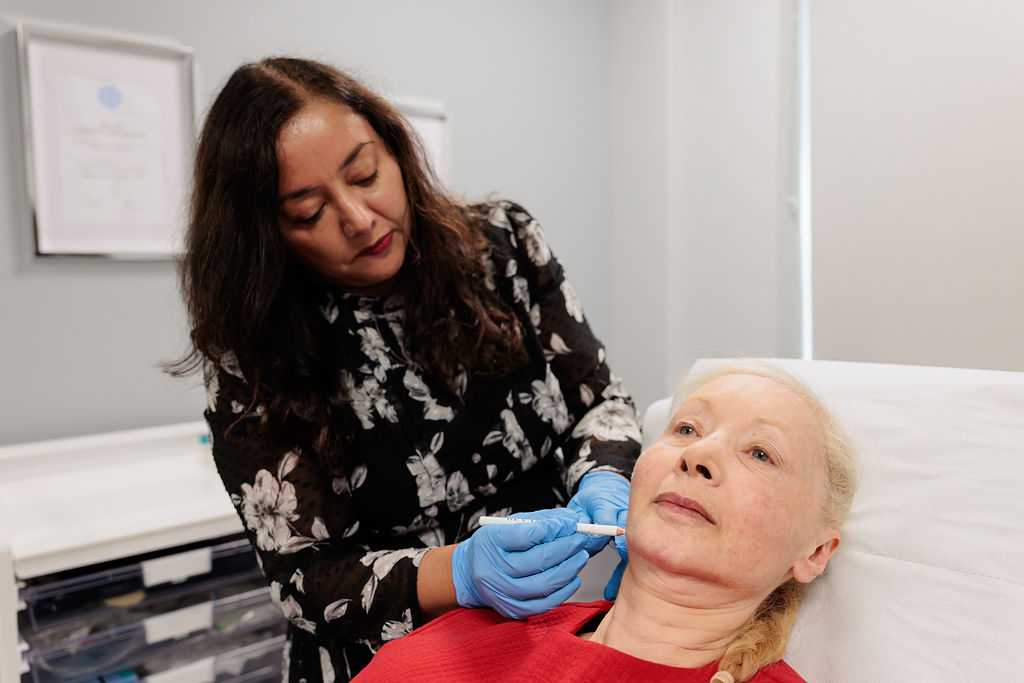
Filler along the jawline can sharpen and define the lower face, while chin filler can improve balance and profile, particularly where the chin is recessed. This is a more structural use of filler and needs careful planning against the rest of the face.
Tear Troughs
The hollows under the eyes that can make you look tired even when you are not. This is one of the most technically demanding areas to treat well, and one where going too heavy or using the wrong product causes visible problems. I am deliberately conservative here.
Non-Surgical Rhinoplasty
Using filler to smooth a bump on the bridge of the nose or improve symmetry, without surgery. This suits a specific set of concerns and is not appropriate for everyone. I will tell you honestly at consultation whether you are a good candidate.
Hands
Volume loss on the back of the hands can make tendons and veins more prominent than people would like. Filler here restores a softer, fuller appearance.






 4.9/5