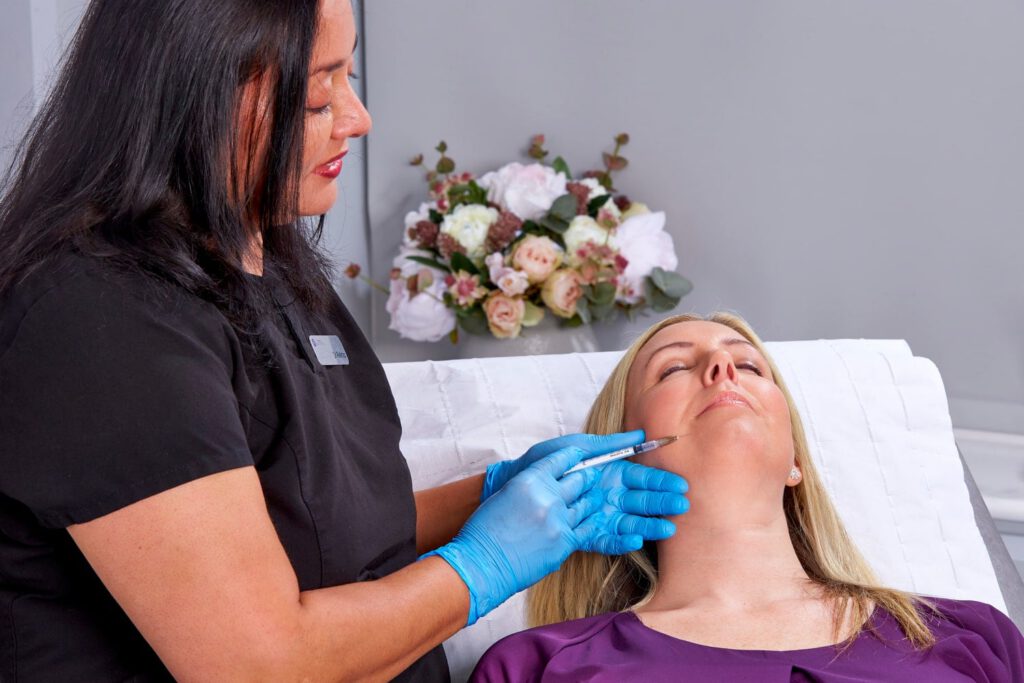
Dermal fillers
This is the mainstay treatment, and for good reason. Hyaluronic acid fillers replace lost volume directly, restoring the natural contour of the cheek and providing support to the mid-face. I use Juvéderm Voluma, which is specifically designed for deep volumising in this area, along with Teoxane’s RHA 4 for cheek contouring and Pure Sense Ultra Deep where a firmer, more structural lift is needed.
The skill here isn’t just injecting product, it’s understanding facial anatomy well enough to place volume where it will actually lift and support, rather than simply filling space. Done well, cheek filler doesn’t just fill the hollow, it can soften the nasolabial folds and even improve jowling, because you’re addressing the cause higher up the face rather than chasing symptoms lower down.
HarmonyCa
HarmonyCa is a genuinely clever product and one I reach for often in this area. It combines hyaluronic acid with calcium hydroxylapatite (the active ingredient in Radiesse), giving you the immediate, mouldable volume of a filler alongside a biostimulatory effect that continues to build collagen over the following months. For sunken cheeks it’s often my first choice, because the correction looks natural from day one and then keeps improving skin quality as time goes on.
Radiesse (diluted, or “wash” technique)
Radiesse itself is a calcium hydroxylapatite biostimulator, and used in its diluted, more superficial “wash” form it works beautifully over a hollow cheek to thicken and firm the overlying skin rather than adding bulk. I use it in combination with structural filler fairly often; the filler restores the contour, and the diluted Radiesse improves the quality and resilience of the skin sitting on top of it.
Julaine of Sweden
Julaine is a poly-L-lactic acid collagen biostimulator, similar in concept to Sculptra but with a technology (LaSynPro) that I’ve found produces very smooth, natural results with a genuinely low risk of nodules. It doesn’t add volume in the way a filler does; instead it stimulates your own type I collagen production gradually over weeks and months. For patients with early hollowing, or those who want a more gradual, “nobody will know I’ve had anything done” result, this is often the treatment I recommend.
Polynucleotides
Polynucleotide skin boosters stimulate fibroblasts and encourage tissue repair, hydration and improved elasticity. They won’t restore lost volume on their own, but where the skin over a sunken cheek has become thin, dull or crepey, polynucleotides are excellent at improving the underlying tissue quality, and I find they pair particularly well with volumising treatments rather than replacing them.
Combination approach
In my clinic, the best results for sunken cheeks nearly always come from combining treatments rather than relying on one alone. A structural filler or HarmonyCa restores the architecture, while Radiesse wash, Julaine or polynucleotides improve the quality of the skin sitting over it. Treating one without the other is, in my opinion, half a job.
This is especially true when hollowing has also begun to affect the hollow temples, or where volume loss lower in the face has started to contribute to jowls — treating the whole mid and lower face together tends to give a more balanced, natural result than isolating a single area.
What to expect from a consultation
Every face hollows differently, and a good consultation should reflect that. I assess bone structure, fat distribution, skin quality and your overall facial proportions before recommending anything, because volumising the wrong area of the cheek can look obvious and unnatural, and that’s the last thing anyone wants. My approach is always to restore rather than to overfill; the goal is a version of your own face that looks rested and well, not a different face altogether.
If you’re concerned about hollowing or sunken cheeks, book a consultation and we’ll talk through what’s actually happening in your face and the most natural way to address it.







 4.9/5