What is hyperhidrosis?
Hyperhidrosis is excessive sweating that goes well beyond normal thermoregulation. It typically affects specific areas of the body rather than the whole surface at once, most commonly the:
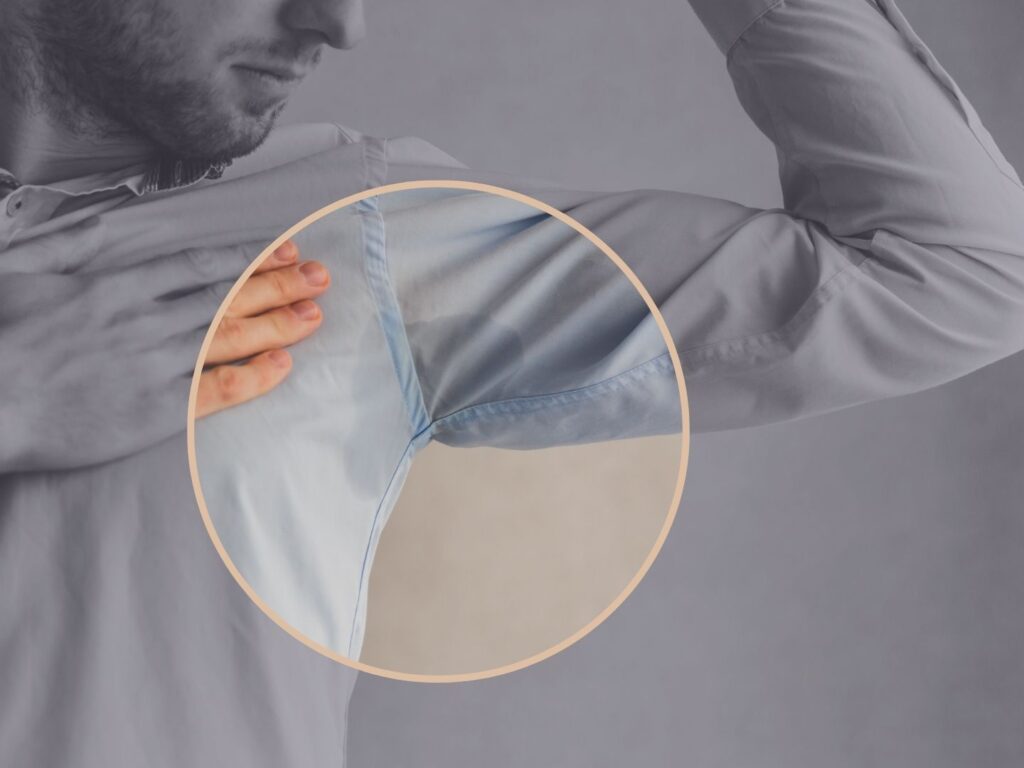
- Underarms (axillary hyperhidrosis) – by far the most common presentation I see, and one of the two areas I treat in clinic
- Face and scalp (craniofacial hyperhidrosis) – the other area I treat, and one that’s often overlooked, though it can be just as socially disabling as underarm sweating
- Palms (palmar hyperhidrosis) – particularly disruptive for anyone who shakes hands for a living, or holds a pen, phone or steering wheel
- Soles of the feet (plantar hyperhidrosis)
At Health & Aesthetics, I treat axillary and craniofacial hyperhidrosis. Palmar and plantar hyperhidrosis are managed differently, and I’ll happily point you in the right direction if that’s what you’re dealing with.
There’s a distinction worth knowing. Primary hyperhidrosis has no underlying medical cause. It tends to start in childhood or adolescence, often runs in families, and affects both sides of the body symmetrically. Secondary hyperhidrosis is triggered by something else entirely, such as an overactive thyroid, menopause, diabetes, certain medications, obesity, anxiety disorders, or occasionally something more serious like a spinal cord problem. It’s usually more generalised and can start suddenly at any age.
This is the first thing I establish at consultation, because the two need different approaches. Treating the sweating without asking why it started would be lazy medicine.
What causes hyperhidrosis?
For primary hyperhidrosis, we don’t have a single neat explanation. What we do know is that the eccrine sweat glands, which cover most of the body and are especially dense on the palms, soles and underarms, are being overstimulated by the sympathetic nervous system, even though there’s nothing to be stimulated about. A strong genetic link exists; if you ask patients whether a parent or sibling has the same issue, a good proportion say yes.
Secondary hyperhidrosis, as above, has an identifiable driver, whether that’s hormonal, metabolic, neurological or pharmacological.
Why it matters more than people assume
I have had patients tell me they’ve turned down promotions because the role involved more presenting. Others avoid silk or pale-coloured clothing entirely. It’s one of those conditions that looks minor from the outside and feels enormous from the inside, and I think it’s under-treated in the UK precisely because people assume nothing can be done about it, or feel embarrassed raising it at all. Please don’t be. It is one of the most satisfying things we treat, because the improvement in quality of life is immediate and obvious.




 4.9/5


