


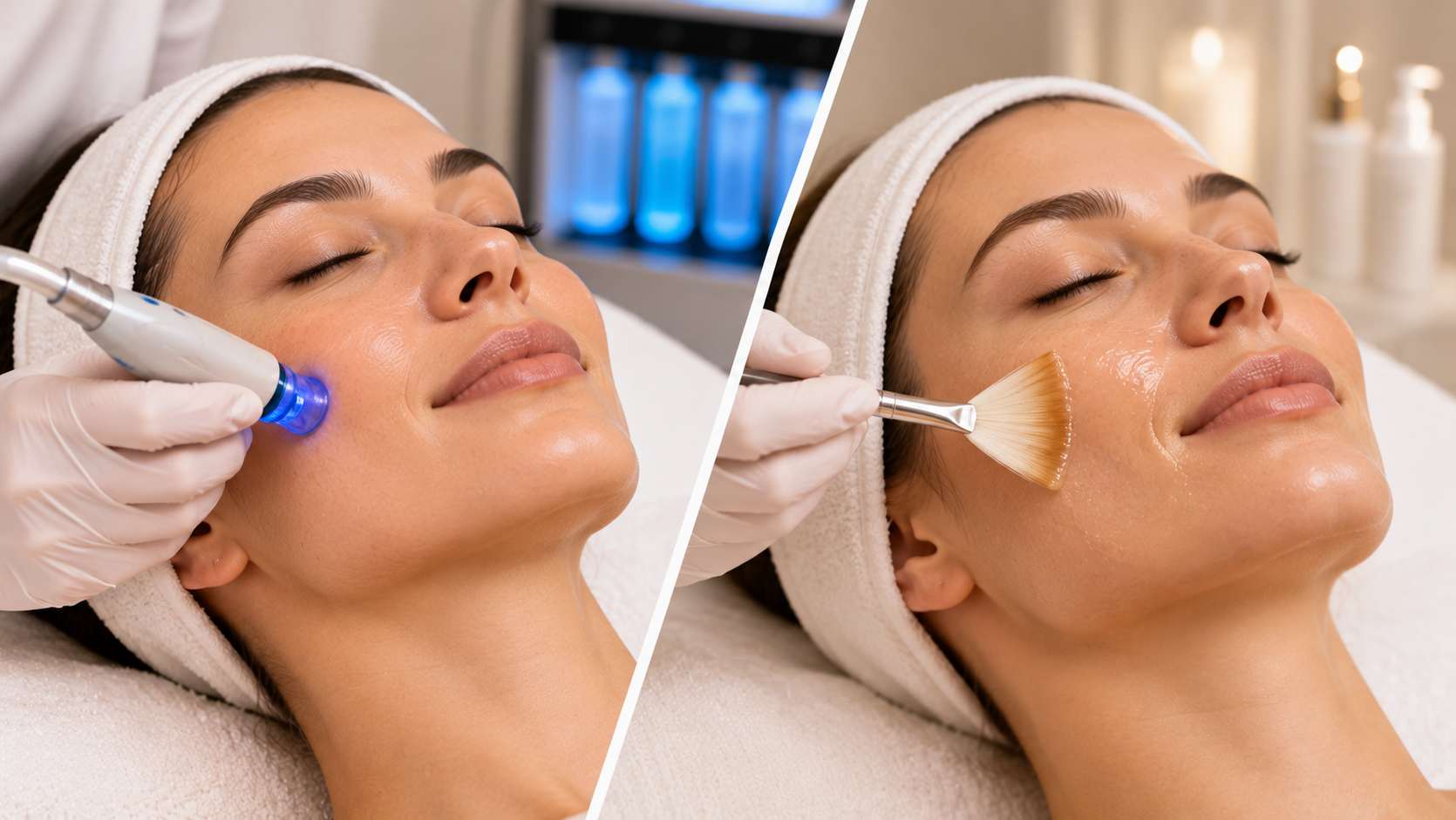
“Should I have a HydraFacial or a peel?” It’s one of the questions I’m asked most often in clinic, usually by someone who has read glowing reviews of both and assumes they do more or less the same job. They don’t. Both will leave your skin brighter, and there’s a fair amount of overlap, but they’re designed for different purposes, and choosing the wrong one is one of the easiest ways to spend good money on your skin and come away slightly underwhelmed.
So here’s my honest view, having offered both side by side for many years.
The Short Answer
A HydraFacial is about how your skin looks and feels right now. A peel is about changing how your skin behaves over the next few months. If you have a wedding on Saturday, book the HydraFacial. If you’re fed up with breakouts, dullness or patchy tone that never quite goes away, a course of the right peel will usually get you further. Most of my patients end up benefiting from both, just at different times and for different reasons.
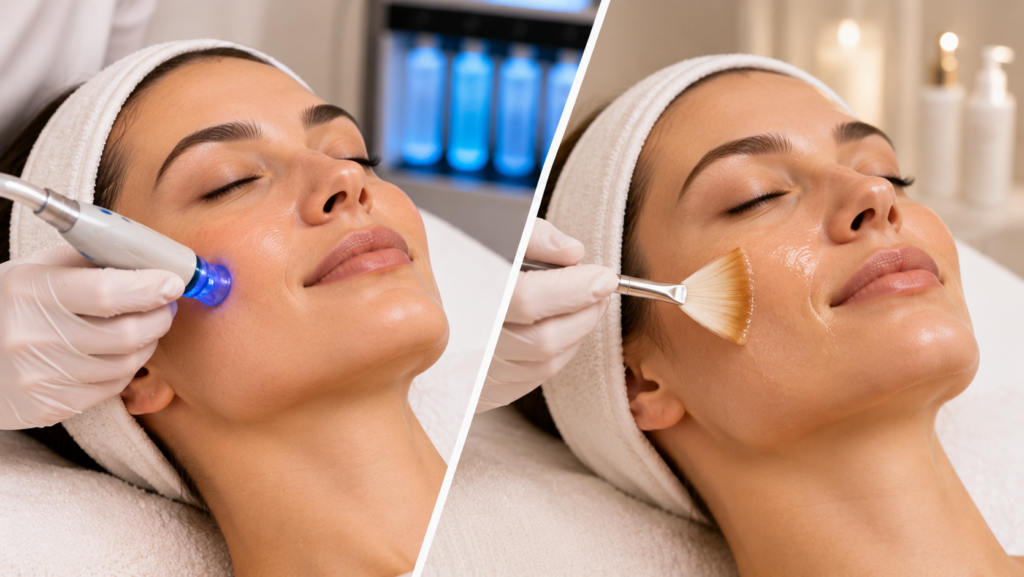
Hydrafacial vs Chemical Peel
What A HydraFacial Actually Does
A HydraFacial uses hydradermabrasion, a vortex of fluid and gentle suction that cleanses, exfoliates, lifts debris out of the pores and then pushes hydrating, antioxidant serums back into the skin. There’s a mild acid step in the middle, a GlySal glycolic and salicylic peel, chosen to suit your skin on the day.
Our Bespoke HydraFacial takes an hour and includes lymphatic drainage, extractions, a booster serum matched to your skin and a 20 minute Dermalux LED session to finish. We also treat the neck, which a surprising number of clinics quietly leave out. For a quicker refresh, the 30 minute HydraFacial covers the core cleanse, exfoliation and hydration.
The boosters are where it becomes properly tailored: DermaBuilder for fine lines, Britenol or ZO Brightalive for uneven tone, a Clarifying booster for congestion, and ZO Rozatrol for red, reactive skin. There’s no downtime at all. You can go straight back to work, or straight out to dinner.
One of my longest standing patients books hers on the Friday before every big presentation and calls it her “armour”. I’ve never once tried to talk her out of it.
What A Chemical Peel Actually Does
A peel works differently. A carefully chosen acid is applied to loosen the bonds between dead skin cells and speed up cell turnover, and over a course of treatments the skin gradually renews itself with fresher, more even cells. Where a HydraFacial is a brilliant all rounder, a peel is a targeted treatment. You pick it for a specific problem, and the results build with each session.
We match the peel to the skin rather than offering one peel for everyone:
- ZO Stimulator Peel: our lunchtime peel, with no real downtime, for brightness, fine lines and uneven tone
- ZO Restorative Peel: a gentle option for sensitive, inflamed or rosacea prone skin, and for anyone who doesn’t tolerate glycolic acid
- Mesoestetic salicylic 10% peel: for oily, congested skin and enlarged pores
- Mesoestetic blemiderm peel: for acne and blemish prone skin
- Mesoestetic melanostop peel: a depigmenting peel that targets superficial pigmentation and lifts dull, uneven tone
All of these are superficial peels. You might notice some tightness or light flaking for a few days, but nothing that keeps you indoors.
The Real Differences
- Purpose: a HydraFacial cleanses, hydrates and refreshes; a peel targets a specific concern
- How it feels: a HydraFacial is cool and pleasant, and more than one patient has fallen asleep; a peel usually brings a few minutes of tingling or warmth
- Results: a HydraFacial gives an instant glow that lasts a week or two; peel results take a little longer to show but are cumulative
- Frequency: a HydraFacial monthly, or every six weeks for a particular concern; peels as a course, spaced a few weeks apart
Where I’ll Be Blunt
A HydraFacial is not a pigmentation treatment, whatever social media might suggest. The brightening boosters help, but established sun damage and melasma need more targeted work. I regularly meet patients who have had a dozen HydraFacials elsewhere for melasma and feel let down. That isn’t the HydraFacial’s fault. It was simply never the right tool.
Equally, more flaking does not mean a better peel. Patients sometimes feel short-changed when they don’t visibly shed, but the Stimulator Peel does real work with very little to show for it on the surface. Judge a peel by your skin at six weeks, not by how dramatic your face looks on day three.
And I’ll be honest about the limits of both. Neither will shift deep lines, acne scarring or heavy sun damage. For that, I’d rather use the Alma CO2 Hybrid Laser or Secret RF microneedling than keep booking facials and peels in the hope they’ll eventually get there.
Finally, a monthly HydraFacial with nothing at home is a lovely treat, not a skincare plan. The daily routine, which for most of my patients means ZO Skin Health, is important between appointments.
Which One Suits Your Skin?
- Dull, dehydrated or tired skin, or an event coming up: HydraFacial, every time
- Blackheads and congestion: a HydraFacial with the Clarifying booster for a quick result, and a course of salicylic peels for longer term control; alternating the two works beautifully
- Active acne: a course of blemiderm peels alongside the right home routine
- Uneven tone and early sun damage: a course of ZO Stimulator Peels, or Melanostop where pigmentation is the main concern
- Melasma: neither on its own; this needs a proper plan, often Cosmelan with ZO at home
- Sensitive or rosacea prone skin: a HydraFacial with ZO Rozatrol or the Restorative Peel, with Excel V+ laser if the redness persists
You Don’t Always Have To Choose
Some of our most popular treatments combine approaches. HydraGenesis pairs a Bespoke HydraFacial with Laser Genesis to stimulate collagen and calm redness, while Genesis Glow combines Laser Genesis with a surface peel. For plenty of patients, the sweet spot is a peel course for correction, followed by regular HydraFacials to keep things ticking over.
A Word On Timing
Autumn and winter are the best time to start a peel course, because lower UV levels make post treatment pigmentation far less likely. A HydraFacial, by contrast, is perfect two to five days before an event. Please don’t try a peel for the first time the week before a wedding, even a gentle one.
A few sensible rules apply to both. We won’t peel anyone who has taken Roaccutane in the last six months, we leave two weeks after injectables or laser, and daily SPF is non negotiable afterwards, grey November mornings included.
Not Sure Which Is Right For You?
The best treatment is the one matched to your skin, not the one your friend swears by. Do get in touch with the clinic to book a consultation, and we’ll look at your skin together and work out whether a HydraFacial, a peel or a combination of both will genuinely give you the result you’re after.
